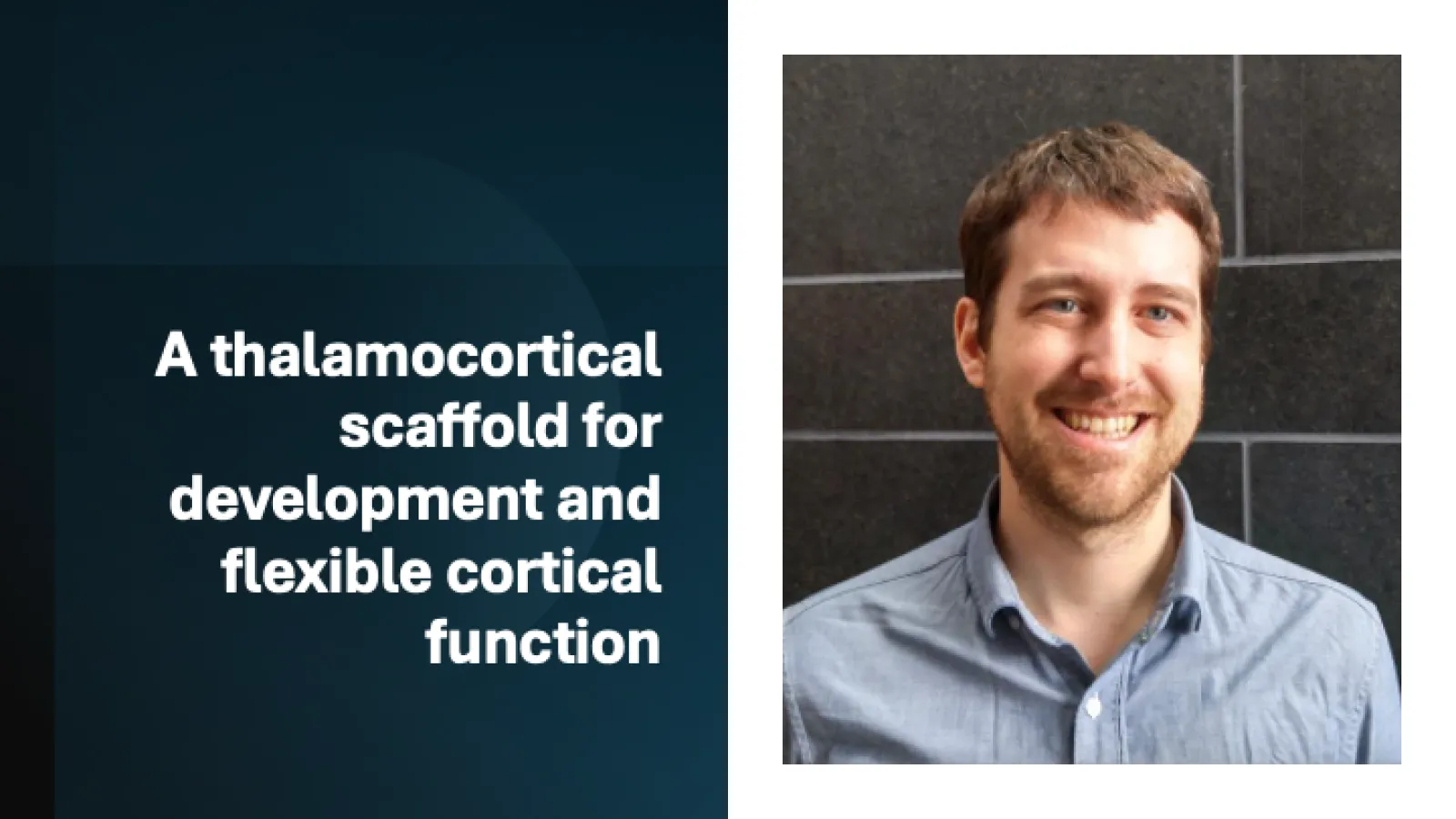
Michael Arcaro is an Assistant Professor of Psychology at the University of Pennsylvania. He received his Ph.D. in Psychology and Neuroscience from Princeton University, where he worked with Sabine Kastner, and completed his postdoctoral training with Margaret Livingstone at Harvard Medical School. His lab combines neuroimaging, behavior, and electrophysiology to study how intrinsic developmental processes and experience interact to shape brain organization, perception, and behavior. Using comparative approaches spanning human infants and adults, macaques, and tree shrews, his research focuses on the development and evolution of the visual system. A central goal of this work is to understand how conserved neural architectures provide a scaffold for functional specialization, and how that scaffold is modified by development, experience, and evolution to support species- and individual-specific behavior.
A thalamocortical scaffold for development and flexible cortical function
Abstract: Cognition depends on the flexible recruitment and coordination of distributed cortical systems as goals, sensory demands, and internal states change. The thalamus is well positioned to regulate these interactions through its widespread reciprocal connections with cortex, but this broad cortical reach raises an organizational question: how can the thalamus support flexible interactions among cortical systems while preserving the specificity of those relationships for coherent behavior? I will show that the adult thalamus contains an orderly, multiscale representation of cortical networks. Across cognitive and conscious states, the spatial organization of this representation is preserved while the strength of thalamocortical coupling varies substantially. Flexible recruitment therefore proceeds by reweighting these interactions rather than reorganizing them. The thalamocortical organization that supports flexible interactions among cortical systems in adults may also help shape their development. In human neonates, we find that thalamic connectivity already mirrors the organization of the adult visual system, indicating that a thalamocortical scaffold is in place before substantial postnatal visual experience. Yet this early organization remains plastic. In congenital sensory loss, we show that higher-order thalamic networks participate in the functional reorganization of deprived cortex. Together, these findings suggest that thalamocortical architecture emerges early yet remains adaptable, constraining cortical development while supporting flexible coordination among cortical systems.