CCBBI's Advancing Distinction in NeuroImaging Research program provides two years of paid mentored research experience and professional development for undergraduate students interested in human cognitive, clinical, developmental, and social neuroscience. To help ADNiR scholars identify a mentor and lab that align with their research interests, they complete rotations in three labs their first summer.
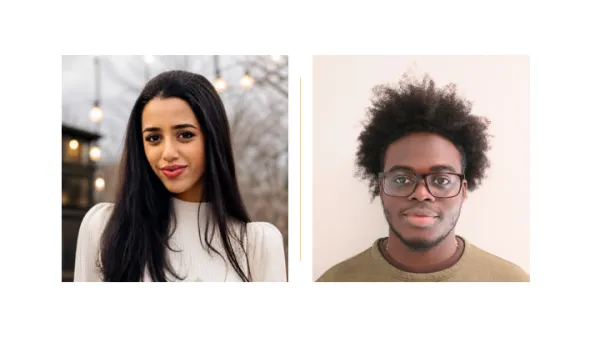
Tanisha Angoth is Behavioral Neuroscience major on the pre-med track. She hopes to build a career that bridges neuroscience research and patient care, with interests in neuroimaging, early detection, diagnosis, and pharmacological interventions. She rotated with Dr. Kristen Hoskinson, Dr. Julie Golomb, and Dr. Hsin-Hung Li. Tanisha has joined Dr. Hoskinson’s lab.
Abeeku Kittoe is a Psychology major on a pre-med track. He is interested in how neuroimaging research can improve patient care for mental health and neurological illnesses, and he plans to specialize in psychiatry. He rotated with Dr. Scott Hayes, Dr. Hasmeet Hayes, and Dr. Jay Fournier. Abeeku has joined Dr. Fournier’s lab.
CCBBI extends our gratitude to the faculty members and their labs for hosting Tanisha and Abeeku this summer.
Read about Tanisha’s and Abeeku’s experiences below.
Please share a little about each of the rotations you completed.
Tanisha: For my first rotation, I worked in Dr. Kristin Hoskinson’s lab at Nationwide Children’s Hospital. I was introduced to pediatric neuropsychology research and had the opportunity to shadow study visits, learn more about neuropsychological assessments, and also gain more experience with data analysis. I especially enjoyed getting to see how research can be applied to understand the cognition and behaviors of pediatric patients.
My second rotation was completed in Dr. Julie Golomb’s lab where I was exposed to research surrounding visual perception and attention. I had the opportunity to work on a multitude of research methods including eye tracking, fMRI, EEG, and TMS. One of the most interesting things I worked on was fMRI analysis using BrainVoyager.
For my third rotation, I worked in Dr. Hsin-Hung Li’s lab which aided in gaining more experience with data analysis. I had the opportunity to work more with MATLAB and learn how such computational methods can be used to process and analyze eye-tracking data.
Abeeku: This summer I rotated with Dr. Scott Hayes’ BBAL lab, Dr. Jasmeet Hayes’ MINDSET lab, and Dr. Jay Fournier’s MIND lab. During my time in the BBAL lab, I focused on QCing MRI data and making sure the scans were free of artifacts that would make further analysis difficult. In the MINDSET lab, I focused on reviewing literature about using Normative analysis methods with MRI data. I worked on QCing in the MIND lab as well, but I also learned about the MIND lab’s specific data processing pipeline.
Which lab have you decided to join? How did you arrive at that decision and what factors influenced your choice?
Tanisha: After I completed all three rotations, I decided to continue working in Dr. Hoskinson’s lab. Each rotation expanded my knowledge in different areas of neuroscience and helped me better understand my own research interests. I was ultimately drawn to the Hoskinson Lab due to its combination of neuroscience, clinical research, and direct relevance to patient outcomes. As a neuroscience student interested in pursuing medicine, I felt that the lab aligned closely with both my research and professional interests. I also really valued the supportive and welcoming environment of the lab, as well as the mentorship I received during my rotation.
Abeeku: I have chosen to join Dr. Jay Fournier’s MIND lab, and my major reason for choosing the MIND lab is that the research focus of the lab aligns most with the area of Neuroscience that I am most interested in.
Tell us about the research project you will be working on in your chosen lab.
Tanisha: Moving forward, I will be performing a preliminary analysis on one of Dr. Hoskinson's ongoing studies, which characterizes the neurocognitive and behavioral functioning of children diagnosed with cancer in early childhood. I am currently exploring a project focused on task performance, emotional regulation, and their relationship with neuroimaging measures. I hope this work will help me better understand how differences in brain structure and function may relate to emotional and behavioral outcomes in pediatric cancer survivors.
Abeeku: I will be working on the MIND lab’s NOMAD study, which focuses on Anger-Hostility as a factor of depression and Anger-Hostility’s association with specific patterns of neural function.