CCBBI would like to extend congratulations to Dr. Justin Palmer and Dr. Qian Yu, awardees of the 2026 President’s Postdoctoral Scholars Program. The President’s Postdoctoral Scholars Program is a prestigious award that recognizes highly qualified postdoctoral trainees who wish to pursue careers in research. The program supports 2 years of salary and benefits, and provides professional development and networking opportunities to scholars.
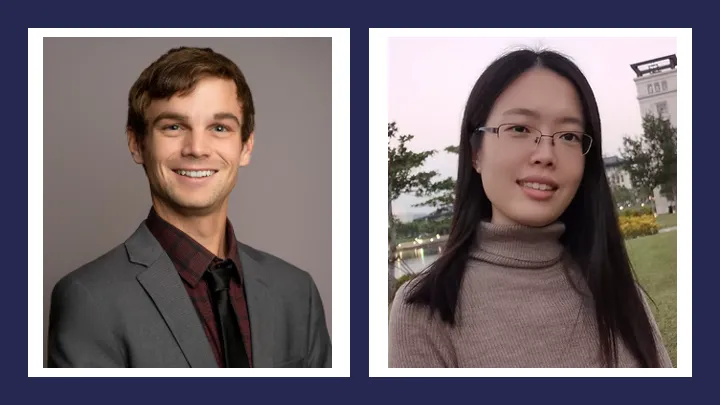
Dr. Palmer is working with Dr. Scott Hayes and Dr. Yu is working with Dr. Ruchika Prakash. Learn more about their interests and pursuits below.
What research/opportunities are you most excited about pursuing?
Dr. Yu: I am most excited about understanding how modifiable lifestyle and behavioral factors, such as mindfulness, can support brain and cognitive health in aging. I am particularly interested in using neuroimaging and intervention studies to better understand the mechanisms underlying healthy cognitive aging.
Dr. Palmer: The hippocampus is well known for its role in memory. Recalling what I had for breakfast this morning or a conversation with a friend last week relies on a healthy hippocampus. Many individuals also understand that being fit can benefit our hippocampus and memory in aging. However, physical fitness is composed of several different components, such as cardiorespiratory fitness, muscular strength, mobility, and body composition. There are limited studies that assess how each aspect of fitness uniquely contributes to hippocampal integrity and memory performance.
To assess hippocampal integrity, many studies use structural and functional MRI to measure volume, cortical thickness, or activation, for example. However, fewer studies focus on cerebral perfusion or blood flow. Perfusion is characterized by the delivery of blood and nutrients to brain tissue over a period of time. Correspondingly, understanding the relationship between cerebral perfusion and memory performance is emerging as a sensitive, early marker for age-related cognitive decline and risk for dementia. Arterial spin labelled MRI (ASL) can assess cerebral perfusion non-invasively. My proposed studies can leverage high-resolution structural images and ASL in order to quantify perfusion within the hippocampus. This is a significant step forward, as many studies that assess perfusion only measure whole-brain perfusion, which may not be sensitive to subtle perfusion changes that occur in the hippocampus. Potentially, measuring hippocampal perfusion may be a better predictor of memory function than global cerebral perfusion.
I am excited to investigate the relationships between physical fitness, memory, and hippocampal perfusion, and whether these relationships vary by age or sex.
Was there something unique about Ohio/OSU/CCBBI that brought you here?
Dr. Yu: I was especially drawn to Ohio State by the opportunity to work with Dr. Ruchika Prakash and to be part of CCBBI’s collaborative neuroimaging environment. The combination of interdisciplinary expertise, excellent research resources, and the President’s Postdoctoral Scholars Program made OSU an ideal place for my postdoctoral training.
Dr. Palmer: I was born and raised in Ohio and completed graduate school in Arizona. I am very fortunate to be able to return home and work in an environment that supports the research I am interested in. The resources here at OSU, and specifically CCBBI, are integral to making this research possible. Many institutions rely on MRI scanners that are shared with medical centers, which can be a barrier to regular use for research purposes. CCBBI has a dedicated scanner for research, and is located in the basement of the Psychology building. This convenience will facilitate the timely completion of my projects.
Additionally, I was very interested in working specifically with Dr. Hayes at OSU. Dr. Hayes has an ongoing longitudinal study in collaboration with Dr. Jasmeet Hayes entitled the Fitness, Aging, Stress, and TBI Exposure Repository (FASTER). Participants involved in FASTER complete comprehensive fitness, cognitive, and MRI sessions that will support my data analysis. 300 participants completed baseline appointments, and three-year follow-up participants are underway. Having access to both cross-sectional and follow-up data will allow me to ask novel research questions related to change over time as well.
What are your aspirations following the postdoctoral position?
Dr. Yu: I hope to pursue a faculty position and establish an independent research program focused on promoting brain and cognitive health across the lifespan, particularly in older adults. I also hope to mentor future researchers and translate our findings into meaningful strategies for healthy aging.
Dr. Palmer: There is a reciprocal relationship between clinical work and research. Research on aging and memory can directly inform and benefit patients, and seeing the challenges patients experience firsthand in the clinic informs future questions to investigate. My background is in both research and clinical neuropsychology among older adults. I desire a career where I can contribute to innovative research and also bring these findings directly to the patients who need it the most. I also find joy in mentoring students and teaching the next generation of clinical scientists. Neuropsychology positions in environments that would allow me to balance all of these desires are important in a future job for me.