Research Day 2026
Research Day is a celebration of the innovative research conducted at CCBBI, featuring presentations from CCBBI faculty, staff, and trainees. In addition, a distinguished invited speaker delivers the Keynote Address.
We are excited to welcome Dr. Marina Bedny, Professor in the Department of Psychological and Brain Sciences at Johns Hopkins University as the Keynote Speaker. Prof. Bedny's research examines how nature and nuture interact during cortical development. Her group explores how early experience shapes cortical specialization, language processing, and perception.
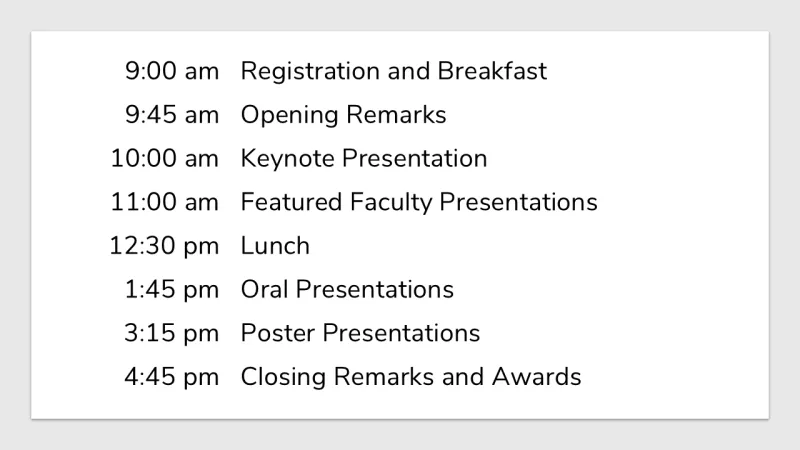
Schedule of Events
Call for Abstracts
We invite submissions involving use of neuroimaging methodologies for oral and poster presentations from undergraduate students, graduate students, post-doctoral scientists, research assistants, and faculty members. Awards will be given for the best talk and poster presentations. The recipients will receive $500 that can be used to attend a scientific conference of their choosing.
Oral presentation Deadline: October 30, 2026 at 11:59PM.
Poster presentation Deadline: December 2, 2026 at 11:59PM
Keynote Presentation

Dr. Marina Bedny
Professor, Department of Psychological and Brain Science
Johns Hopkins University
Language and sensory experience - insights into nature/nurture and human adaptability.
How do nature and nurture interact during cortical development? Anthropologists have long pointed out that humans occupy a wide range of habitats. Most humans live in environments far different from those in which our brains evolved. Early sensory differences, like blindness and d/Deafness, are an example of niche diversity and provide a window into the mechanisms of human cortical specialization.
I will discuss studies of language neurobiology across populations with diverse sensory experiences: congenitally blind braille readers and d/Deaf signers. I will make three points. First, there is a recent revival of the view that human brains are all functionally "the same.” Comparing visual cortex function across blind and sighted adults as well as infants suggests otherwise. The visual cortices of congenitally blind adults are robustly and selectively activated by braille and spoken language. A unique case study of an individual with sight recovery suggests that early blindness enables visual cortices to take on language and braille reading functions, and this developmental pattern of "cross-modal" plasticity is not undone even by 25 years of vision in adulthood. Data from sighted infants suggest that "cross-modal" responses in blindness have their roots in patterns of infant brain connectivity. Cortical function is not invariant across individuals but rather is shaped by early experience. Once established, functional patterns are stable in adulthood.
Next, I will discuss the case of language neurobiology in d/Deaf signers. The function of the frontotemporal language system is highly conserved across hearing speakers and d/Deaf signers, modulo modifications in lateralization. I will discuss recent evidence showing that, in both hearing speakers and d/Deaf signers, the frontotemporal language system is functionally specialized for word meaning and grammar and functionally separate from working memory and the "plot" systems of the brain. In signers, even "iconic" motion verbs show language-specific and highly abstract representations in lateral temporal verb-sensitive areas of the language network, similar to hearing speakers. Moreover, these responses are robust to variations in early language experience. Most d/Deaf children are born to hearing families and are at risk of experiencing varying degrees of delay in language access that are associated with well-documented behavioral differences, including reduced mastery of phonology and sentence-level grammar. One hypothesis is that these behavioral differences occur because the frontotemporal language network has failed to specialize for language. Contrary to this hypothesis, we find that the frontotemporal language system is highly selective for language and encodes linguistic information even in signers with severely delayed language access. However, late learners show enhanced recruitment of domain-general working memory systems during language processing. This suggests that the language system is at least as prepared for language as the visual system, although its processing efficiency is affected by delays in language access.
Lastly, I will discuss the interface of the language system with perception. While many core properties are conserved across signed and spoken languages, sign languages use the hands, face, and space to convey meaning and grammar. Preliminary evidence suggests that parts of the face and body perception system become specialized for language perception in d/Deaf signers. The human language system is highly flexible in its output channels, and the neurobiological basis of linguistic symbols depends on their modality.